


Yes, you can trek the Annapurna Circuit in July, but plan for rain. The lower Marsyangdi valley gets heavy monsoon rain (Pokhara averages 941 mm in July), while the Manang to Jomsom side sits in a rain shadow (Jomsom averages 47 mm). The trails are quiet, rooms are easy to find and the valleys are green. The main risks are landslides on the Besisahar to Chame road, leeches below about 2,500 m, cloud hiding the peaks and cancelled Jomsom flights. Carry rain gear, allow two or three spare days, and start the 5,416 m Thorong La before dawn.
- SeasonSummer monsoon (June to September)
- July rain, PokharaAbout 941 mm
- July rain, JomsomAbout 47 mm
- Highest pointThorong La, 5,416 m
- Biggest risksRoad landslides, leeches, flight delays
- PermitsACAP and TIMS, licensed guide required
Annapurna circuit trek is one of the most diverse and visually appealing treks in Nepal and the entire world. This classic circuit of the Annapurna region is 12 days to 18 days long. The trek used to start at Besisahar. Most groups now ride a jeep further up the Marsyangdi valley to Jagat, Dharapani or Chame and start walking there, then the route traverses around the terrific Annapurna region through lush green forests, mountains, high-altitude passes, small villages, landscapes, etc. It is considered moderately difficult. It is long and tiring, but fit beginners who train for a few months can complete the Annapurna circuit trek. The highest landmark of the trek is the Thorong La Pass (5,416 m / 17,769 ft).
The Annapurna circuit trek passes through villages like Pisang, Manang, Marpha, Chame, Yak Kharka, Thorong Phedi, etc., that reflect typical Nepali lifestyle and cultural and traditional practices of different ethnic groups like the Gurung, Thakali, and Manangi. Marsyangdi River, Kali Gandaki River, Muktinath temple, the old Braga Gompa near Manang, Thorong La pass, beautiful Yak pastures, numerous Buddhist shrines, etc are some of the most sought-after attractions of the Annapurna circuit trek.
July falls in Nepal's summer monsoon, when the lower valleys get heavy rain on most days. The upper part of the circuit, from Manang over the Thorong La to Jomsom, sits in the rain shadow of the Annapurna range and stays far drier. Even there, expect some showers. If you don't mind the rain, the Annapurna Circuit trek in July is your cup of tea.
Weather of the Annapurna Circuit Trek in July
Temperature wise, July is one of the warmest months on the circuit. Pokhara, the gateway city, averages 30 °C by day and 22 °C at night in July, and the lower Marsyangdi valley is just as hot and humid. Jomsom (2,720 m), on the far side of the pass, averages 23 °C by day and 14 °C at night (WMO and Department of Hydrology and Meteorology normals, 1991 to 2020). Higher up, around Thorong Phedi (4,540 m) and the pass, nights drop close to freezing and fresh snow is possible.
Typical days of July throughout the trek are characterized by mildly warm days and cool nights. Due to rainfall, the sky tends to get cloudy which might affect the panoramic views. After rainfall, the vegetation and forests around look greener and merrier and the water level in river and streams increase. Mornings are often the clearest part of the day, and cloud builds through the afternoon until rain sets in by evening.

Photo: Captivating panorama of the Annapurna Circuit Trek amidst the July monsoon.
How Much It Rains: Lower Circuit vs Rain Shadow
Two weather stations on either side of the range show the gap. Pokhara, south of the Annapurnas, averages 941 mm of rain in July. Jomsom, behind them on the circuit's western side, averages 47 mm. Twenty times less.
| Station | Altitude | July rain (average) | |
|---|---|---|---|
| Pokhara (gateway city) | 822 m | 941 mm | |
| Jomsom (rain-shadow side) | 2,720 m | 47 mm |
Source: World Meteorological Organization and Nepal's Department of Hydrology and Meteorology, 1991 to 2020 averages. The lower Marsyangdi between Besisahar and Chame gets heavy monsoon rain much like Pokhara, while Manang (3,540 m) sits in the drier zone. We found no long-term station record for Manang village itself, so treat it as "drier than Chame, wetter than Jomsom".
Food and Accommodation During July
Unlike during the peak season months getting a room in teahouses in July throughout the Annapurna circuit trek is quite easy as there is more supply than demand. Now let's talk about the cost of food and accommodation. Typical breakfast on the trail comprises eggs, tea, roti (pancakes), coffee, etc. On average, it is covered by $6 to $10. The lunch on the Annapurna Circuit trek is noodles, dumplings, thukpa, chowmein, etc. An estimated $5 to $10 is more than enough for lunch per day. For dinner, most of the teahouses serve Rice, lentils, tomato pickle, spinach, goat meat, chicken meat, etc. While on lower altitude the typical Nepali dinner costs $5 but on higher altitudes it costs from $8 to $10. You can either carry your own water bottle and refill it or buy bottled water that costs around $1 to $5.
A typical accommodation in the Annapurna circuit trek is a teahouse. Rooms in these teahouses have twin beds, warm blankets, pillows, and a shared bathroom. The cost per night for these rooms is approximately $5 to $10. Some of the tea houses in the Annapurna circuit provide free electricity services, hot water, and Wi-Fi services while some take $2 to $3 extra so do not forget to ask the owners about it beforehand.
NOTE: the amount you pay for food and accommodation varies with the luxuries you expect. These are the price rate of teahouses not the hotels of city areas like Pokhara and Kathmandu.
Pros and Cons of Trekking the Annapurna Circuit in July
PROS:
-
The trails of the trek are less crowded.
-
Getting rooms in the teahouses throughout the Annapurna Circuit trek is easy.
-
Greener forests, blooming flowers and clean air after the rain.
-
Some lodges drop their room rates when the trails are quiet, so you may save a little.
-
Sunrise views on the mornings when the sky clears.
-
The most photogenic sceneries around the year ( wildlife, scenic photographers, here's for you guys)
CONS:
-
Except for the rain shadow area, there is continuous rainfall which makes it hard to trek.
-
There are gloomy clouds that obstruct the panoramic views.
-
As the environment is damp you will be troubled by mosquitoes.
-
High possibility of the trail being blocked due to a landslide hampers trekking through the Annapurna circuit.
-
Trails are muddy and slippery due to heavy rainfall.
-
Possibilities of flood and landslide.
-
In the trail through forests and grassy lands, there are leeches around.
-
As every day the weather is not good enough for long treks the duration of the trek increases compared to the non rainy seasons.

Photo: Cloud-filled skies on the Annapurna Circuit trek in July.
July Risks on the Annapurna Circuit at a Glance
Most July problems come from water on the lower road, not from the trail above Manang. This is how each risk compares in a typical monsoon.
| Risk | Level in July | Where and why |
|---|---|---|
| Landslides on the road | High | Besisahar to Chame, and Jomsom to Beni on the way out. Blockages can last hours or days. |
| Cancelled Jomsom flights | High | Cloud over the Kali Gandaki often stops the short flight to Pokhara. |
| Leeches | Moderate | Forest and grass below about 2,500 m, mostly the first two days. |
| Cloud hiding the views | Moderate | Worst in the lower valley. Mornings in Manang are often clear. |
| Thorong La crossing | Moderate | Usually snow-free, but afternoon cloud, sleet and wind are common. Start before dawn. |
| Rain on the Manang to Muktinath stretch | Low | Rain shadow. Showers happen, downpours are rare. |
| Altitude sickness | Same as any season | The pass is 5,416 m in every month. Acclimatise in Manang. |
Getting In and Out During the Monsoon
The jeep road up the Marsyangdi is the weak link. It cuts across steep slopes, and heavy rain brings rock and mud down onto it. It happened again at the end of the 2026 monsoon. Floods and landslides in late September closed the Besisahar to Chame road for several days and left trekkers waiting in Manang. By 12 October, IANS reported that trail clearing had reopened the route, Thorong La included, with 150 to 200 trekkers a day passing the Dharapani checkpoint.
On the far side, the Jomsom to Pokhara flight takes about 20 minutes, but cloud grounds it often in July. The road down the Kali Gandaki to Beni is the backup, and it has landslide sections of its own. Build two or three spare days into a July circuit and keep your international flight well clear of your planned finish.
Permits Required for the Annapurna Circuit Trek
Trekking through the Annapurna Circuit trek needs you to trek through the Annapurna Conservation Area and roaming around here is strictly prohibited without permission (permit). Permits required for the Annapurna Circuit trek in July are as follows:
-
Annapurna Conservation Area Permit (ACAP) - It costs NPR 3,000 (about USD 20), or NPR 1,000 (about USD 7) for SAARC nationals. Bought at a checkpoint on the trail, it costs double.
-
Trekkers Information Management System card (TIMS) - It costs NPR 2,000 (about USD 13) and NPR 1,000 for SAARC nationals, issued through a registered trekking agency. A licensed guide has also been mandatory on the circuit since April 2023. See our solo trekking rule explainer. The full process is in our Annapurna Circuit permits guide.
What to Pack for the Annapurna Circuit Trek in July
According to the weather and condition of the trails you need to get your backpacks ready. Here are some of the necessities you gotta have:
-
Waterproof jackets
-
Waterproof trekking boots
-
Gloves
-
Sunblock
-
Light jackets
-
Hats
-
Trekking stick
-
Navigation tool/map
-
First aid box (ask your doctor before the trip about altitude medicine such as acetazolamide)
-
Water bottle
-
Power banks
-
Loose long sleeve t-shirt
-
Energy giving snacks
-
Solar chargers
-
All of the travel documents required
-
Disinfectant
-
Leech socks or long gaiters for the lower trail
-
Rain cover for your pack and dry bags for clothes
-
Quick-dry trekking clothes (cotton stays wet for days in July)
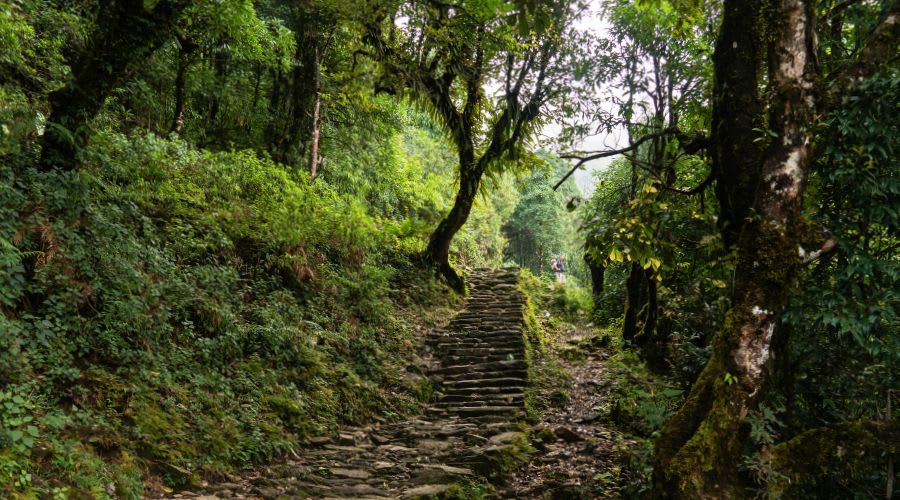
Photo: A lush green trekking trail on the Annapurna Circuit in July.
Highlights of Trekking During July
-
Cross the Thorong La pass, 5,416 m (17,769 ft).
-
Soak in the natural hot spring at Tatopani if you continue down the Kali Gandaki below Jomsom.
-
Walk the Kali Gandaki Gorge, often called the deepest gorge in the world
-
Views of Mt. Dhaulagiri 8,167 m (26,795 ft), Mt. Annapurna I 8,091 m (26,545 ft), Nilgiri Himal 7,061 m (23,166 ft), Annapurna South 7,219 m (23,684 ft), Annapurna II 7,937 m (26,040 ft), Annapurna III 7,555 m (24,787 ft), Annapurna IV 7,525 m (24,688 ft), Hiunchuli 6,441 m (21,132 ft), Machhapuchhre 6,993 m (22,943 ft), Tukuche Peak 6,920 m (22,703 ft) and Lamjung Himal 6,983 m (22,910 ft). In July, cloud hides them for long stretches, so the clear mornings count.
-
Observing the exotic flora and fauna of the Annapurna Conservation area.
-
Sunrise from Poon Hill, if you finish the trek through Ghorepani.
-
Trekking through small Nepali villages observing traditions, cultures, and lifestyles of the local ethnic groups, namely Gurung, Manangi, Thakali, Magar and others.
-
Walk both the Marsyangdi and the Kali Gandaki valleys
-
Explore the Muktinath ( one of the most valued pilgrimage sites for Buddhists as well as Hindus).
-
Trek through Marpha, the apple capital of Nepal, with its stone-paved lanes.
-
Walking on the trail that is decorated with lush green forests, cascading waterfalls, and terrific landscapes.
Festivals Around the July Circuit
July itself is quiet. Wait a few weeks, though, and the rain-shadow villages celebrate Yartung, a horse-racing and harvest festival held after the monsoon in Muktinath and Lo Manthang. In 2026 it ran from 17 to 19 August. A lama sets the date each year, so check before you plan around it. Tiji, the other famous Mustang festival, falls in May.
Rain-Shadow Alternatives for July
If you want the drier half of the circuit without the wet approach, look north. Upper Mustang gets very little monsoon rain and is at its greenest in July and August, though it needs a restricted area permit (see our Upper Mustang permits guide). Nar Phu, a side valley off the circuit, is another option. Our monsoon rain-shadow trekking guide compares them.
Also Read:
Annapurna circuit trek in April | Annapurna circuit trek in winter | Annapurna circuit trek map
Suggestions to Make Your Trek in July Easier
-
As the Annapurna circuit trek is long and goes up to very high altitude make sure to acclimatize enough to avoid altitude sickness. Most itineraries spend at least one night in Manang (3,540 m), and many add a rest day there before Yak Kharka and Thorong Phedi.
-
While on the trail to protect yourself from leeches carry some salt with you. If you find leeches sucking on you simply, pull it off from your skin and put a pinch of salt on the leech.
-
Find a genuine travel insurer and get travel insurance that covers trekking to 5,500 m and helicopter evacuation.
-
For beginners aiming for the Annapurna Circuit trek go for a few short hikes to prepare yourself physically.
-
A licensed guide is required on the circuit, so book guides and porters through a registered trekking agency.
-
Annapurna circuit is a gem of Nepal therefore do follow the principles of responsible trekking. Do not damage anything or pollute nature, and be civilized throughout.
-
Always keep track of the weather to avoid heavy rainfall.
-
When it pours, wait it out in a teahouse rather than walk under landslide-prone slopes.
-
Eat warm food and stay hydrated to have yourself immune from the possibility of catching a common cold.
-
Last but not least respect remote Nepal's lifestyle and the beliefs of local people.
Annapurna Circuit in July: FAQs
Is the Annapurna Circuit open in July?
Yes. Teahouses stay open and the trail is walkable, but landslides can close the jeep road for hours or days. Allow spare days.
Does it rain on the Thorong La in July?
Less than in the lower valley. The pass sits in the rain shadow, but afternoon cloud, sleet and wind are common, so cross early in the morning.
Are there leeches on the Annapurna Circuit in July?
Yes, in the forest and grass below about 2,500 m, mainly on the first days up the Marsyangdi. Leech socks and a little salt help.
Can I fly out of Jomsom in July?
Sometimes. The flight to Pokhara is short, but cloud often grounds it. The road to Beni and Pokhara is the backup, and it has landslide sections too.
Is the Annapurna Circuit better than Everest Base Camp in July?
For July, yes, for most people. Half of the circuit sits in a rain shadow, while the Khumbu gets monsoon rain and Lukla flights are often grounded. See our guide to the Everest Base Camp trek in July.