
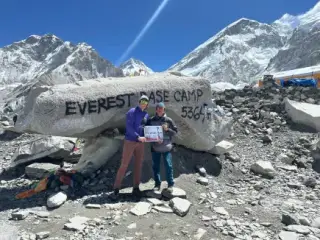
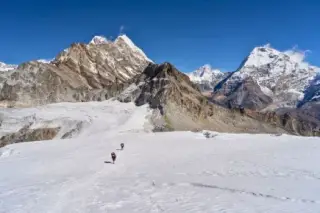

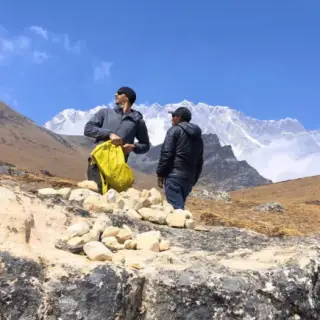



Sherpas are a Tibetan Buddhist ethnic group from the Solukhumbu district of north-east Nepal, the district that holds Mount Everest. Their ancestors came from Kham in eastern Tibet several centuries ago, and the name means "people from the east". Nepal's 2011 census counted 112,946 Sherpas. They follow the Nyingma school of Buddhism, speak Sherpa, a Tibeto-Burman language, and celebrate Gyalpo Losar (18 February 2026), Dumje in early summer and Mani Rimdu at Tengboche (26 to 28 October 2026). Food is Tibetan at heart. Think tsampa, shakpa stew, potato pancakes and salty butter tea.
- HomelandSolukhumbu, Koshi Province, Nepal
- OriginKham, eastern Tibet
- Population112,946 (2011 census)
- LanguageSherpa (Tibeto-Burman)
- ReligionNyingma Tibetan Buddhism
- Main festivalsLosar, Dumje, Mani Rimdu
- Village altitudeAbout 2,400 to 4,400 m
- Famous SherpaTenzing Norgay, Everest 1953
Sherpas are typically the first thing that comes to mind when people think about Nepal. Sherpas are an ethnic group best known for their mountaineering skills and have played a key role in many Everest ascents.
Sherpas are indigenous to the eastern Himalayas, and their culture and traditions are heavily influenced by their Buddhist faith. In this article, we'll take a closer look at the history and culture of Nepal's Sherpas and some of their traditional festivals and cuisine.

The History of the Sherpas
The Sherpas are an ethnic group from the most mountainous region of Nepal. The name "Sherpa" comes from Shar-wa, which means "eastern people" in Tibetan. Their ancestors came from Kham, in eastern Tibet, and crossed into Nepal several centuries ago. Estimates run from the 13th to the 16th century, and Sherpa oral history tells of four founding clans that arrived at different times, mostly over the Nangpa La pass. They primarily live in the Solukhumbu district of Nepal, which includes Mount Everest. Nepal's 2011 census counted 112,946 Sherpas, about 0.4% of the population, and more live in Darjeeling and Sikkim in India.
The Sherpa people are known for their mountaineering skills and ability to guide climbers on expeditions to peaks such as Mount Everest. Sherpas are an ethnic group indigenous to the high Himalayas of Nepal. The word "Sherpa" means "easterner," and they're considered one of the ancient ethnic groups in Nepal.

Their history is closely intertwined with the history of Mount Everest. They've been living in the mountains for centuries, and many of them are expert climbers. Tenzing Norgay, a Sherpa, together with Edmund Hillary, made the first ascent on 29 May 1953 of Mount Everest.
Over the years, the Sherpas have developed a rich culture and cuisine that is unique to their region. Festivals are a big part of their culture. They celebrate everything from the New Year to marriage and harvest festivals. Their cuisine is based on simple, hearty dishes perfect for mountain living.
Understanding the Culture and Festivals
They have a rich culture and tradition that is based on Buddhism. The Sherpa language belongs to the Tibeto-Burman language family and is closely related to Tibetan. Most Sherpas follow the Nyingma school, the oldest of the four schools of Tibetan Buddhism, and nearly every village has a gompa, mani stones carved with prayers and a row of prayer wheels. Festivals are an essential part of their culture, and numerous of them occur throughout the year. Some of the most important festivals are the Losar new-year festival, the Mani Rimdu festival, and the summer Dumji festival.
Losar, the Sherpa and Tibetan new year (Gyalpo Losar), falls in February or early March, on 18 February in 2026, and is a moment for family and friends to get together, feast, and celebrate. The Mani Rimdu festival is a religious festival with masked dances, held in autumn at Tengboche and Chiwong and in spring at Thame.
It is a time for prayer and meditation and is considered one of the year's most important festivals. The Dumji festival, held each summer in village monasteries, honours the birth of Guru Rinpoche and is considered among the most important festivals in the Sherpa calendar.
Sherpa Festival Calendar
Sherpa festivals follow the Tibetan lunar calendar, so the dates move by a few weeks each year. The blue months show when each festival usually falls.
| Festival | When | What happens | Where to see it |
|---|---|---|---|
| Gyalpo Losar | Feb to early Mar 18 Feb 2026 JFMAMJJASOND | New year. Houses are cleaned, prayer flags renewed, families feast and monasteries hold dances. | Every Sherpa village, and Boudhanath in Kathmandu |
| Dumje | Jun to Jul Set by the lunar calendar JFMAMJJASOND | Honours the birth of Guru Rinpoche. Village households take turns to host and pay for the feast. | Namche, Khumjung, Thame, Pangboche |
| Mani Rimdu | Oct to Nov 26 to 28 Oct 2026 (Tengboche) JFMAMJJASOND | Masked chham dances, the Wong blessing and a fire ritual at the end. | Tengboche and Chiwong in autumn, Thame in spring |
Mani Rimdu is the easiest one for trekkers to plan around. Our Mani Rimdu guide covers the 2026 programme, and the Tengboche Monastery guide explains where the dances take place.
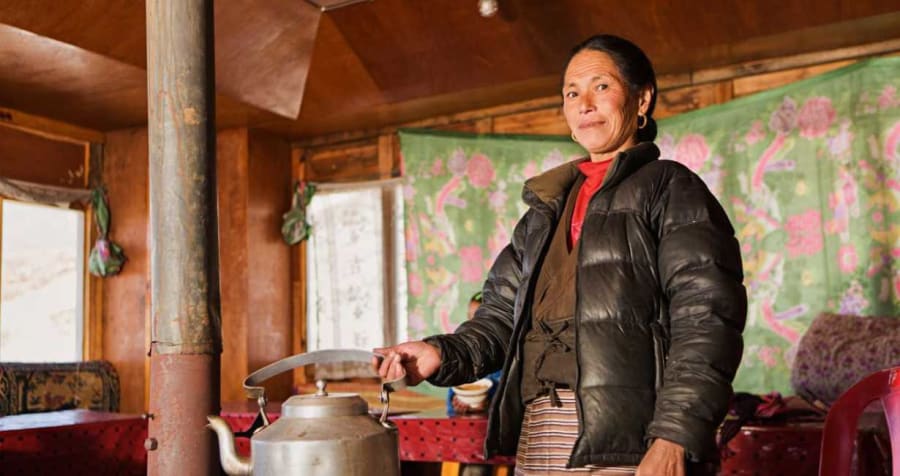
The traditional clothing of the Sherpa people is very colorful and distinctive. Men traditionally wear a long robe called a chhuba tied at the waist, while women wear an ankle-length dress (angi) with a striped woollen apron, and both adorn themselves with jewellery of silver, coral, and turquoise. The history of the Sherpa people is fascinating, and their culture is unique and rich.
Exploring the Cuisine of Nepal's Sherpas
The Nepalese Sherpas are renowned for their mountaineering skills, but they are also masters of the kitchen. Their cooking came with them from Tibet and still leans on barley, potatoes, yak dairy and salt, though Nepali dal bhat is now on most Khumbu tables too.
One of the most popular dishes is momo, a dumpling made with chicken, beef, or vegetables. Another favorite is thukpa, a hearty soup made with noodles, meat, and vegetables. In Sherpa homes you'll also meet shakpa, a thick stew of hand-torn noodles, potato and meat, and riki kur, a potato pancake eaten with yak butter or soft cheese. All of it goes down with salty butter tea. Our list of 10 Sherpa foods to try on the EBC trek tells you where to order each one.
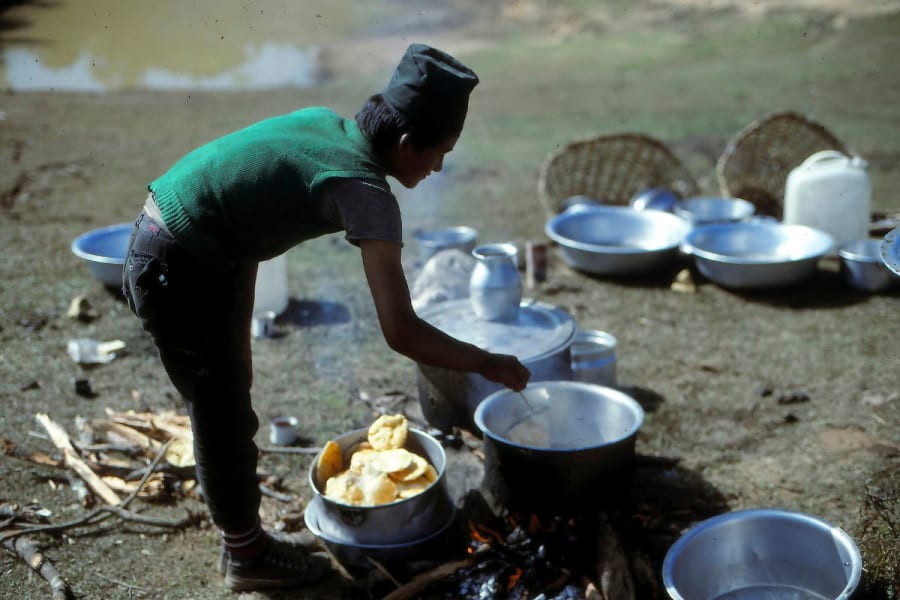
Sherpa cuisine is hearty, filling, and perfect for satisfying your hunger after a long day of trekking in the mountains. So be sure to sample some delicious dishes when you visit Nepal!
Many Sherpa families own yak herds, which they use for transportation and dairy products. Yak butter and cheese are staples of the Sherpa diet, as well as potatoes, tsampa (a type of roasted barley flour), meat, and vegetables.
Uniquely-Crafted Handicrafts by the Sherpas
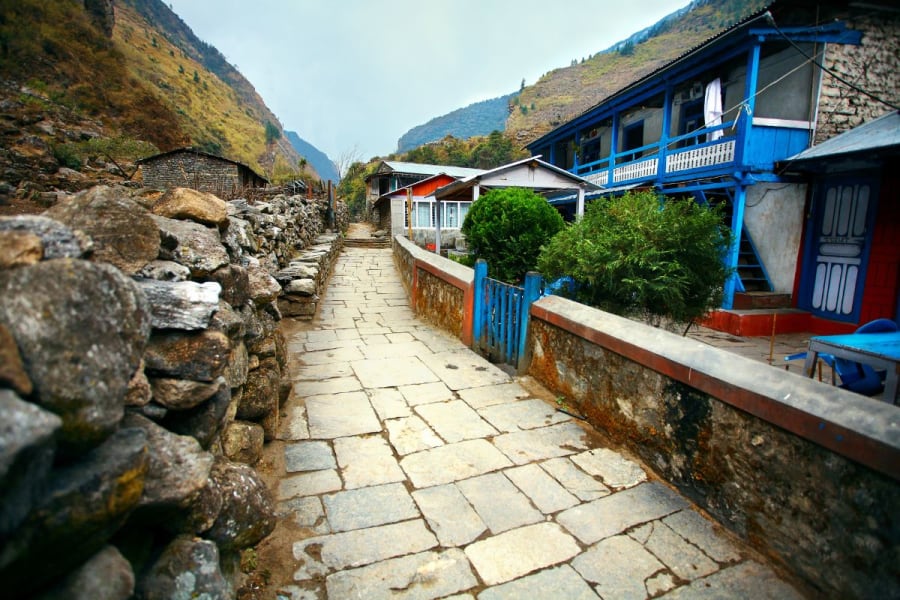
The Sherpa people of Nepal are known for their unique handicrafts. The intricate features of their embroidery, weavings, and jewelry have been preserved for centuries. They create beautiful items to be used as decorations or for religious purposes.
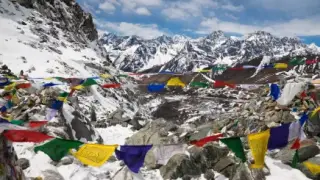
For example, the intricate and colorful prayer flags hung in homes and at mountain passes during festivals. These flags come in five colors, one for each element: blue for space, white for air, red for fire, green for water and yellow for earth. They also make spinning prayer wheels packed with paper scrolls of the mantra Om Mani Padme Hum.
Whether jewelry or fabrics crafted from traditional looms, Sherpa families have passed countless traditions through the generations. The bright colors and unique patterns make each item stand out and offer visitors a glimpse into a rich culture that has stood the test of time.
Trekking With a Sherpa Guide in Nepal
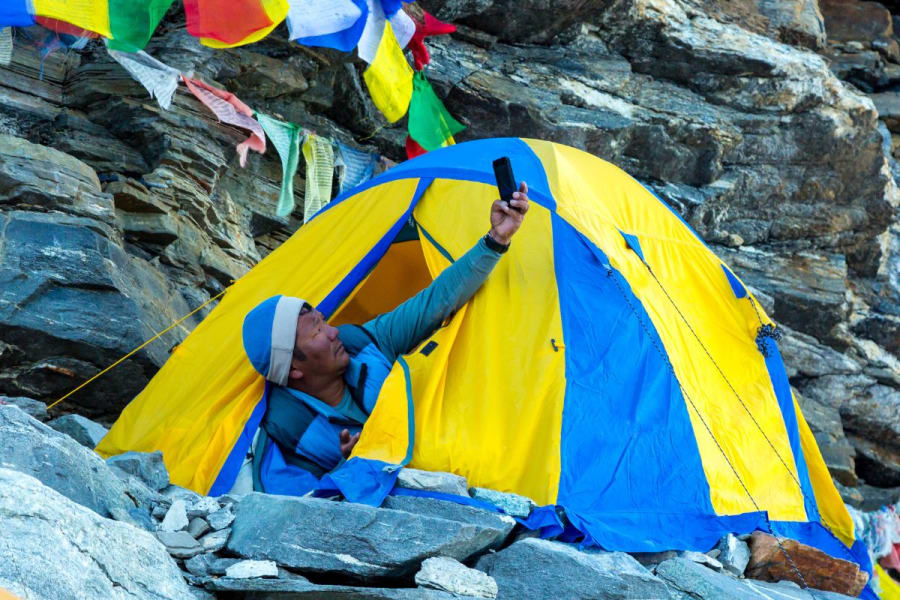
The Sherpas are an ethnic group from Nepal known for their mountaineering skills. They have a long history of living in the Himalayan mountains, and their culture and traditions are closely linked to this environment. Sherpas have a reputation for being hardy and dependable, and they are often hired as guides and porters on mountaineering expeditions. The Sherpas' homeland is the Solukhumbu region of Nepal, where most villages sit between about 2,400 m in Solu and 4,400 m at Dingboche, under peaks that pass 8,000 m. Today, they play a vital role in Nepal's tourism industry as guides and porters.
Trekking with a Sherpa guide in Nepal is one of the finest experiences you can have in the Himalayas. Walking beside your Sherpa guide, you'll get incredible insight and information about their culture, traditions, and the most beautiful places of Nepal while exploring.

Your Sherpa guide will provide guidance and support throughout your journey, ensuring a safe trekking experience along some of the most challenging terrains in the world. They're also skilled yak handlers, cooks, and porters who know how to handle all types of conditions. Plus, they're incredibly knowledgeable about local flora and fauna, so you'll gain unique perspectives to observe on your trek.
From climbing peaks to discovering secluded temples, they'll also offer insight into local customs and traditions, from festivals to religious ceremonies to cuisine. Truly an opportunity, trekking with a Sherpa guide gives you access to some of Nepal's most beautiful secrets, stories, and experiences!
In trekking slang, "sherpa" with a small s has drifted into a job title for any mountain guide or porter. Plenty of guides on the Everest trail are Sherpa. Many others are Rai, Tamang, Gurung or Magar, and they know the route just as well. Sherpa with a capital S is an ethnic group, and also the surname most Sherpas carry, which is why so many famous climbers share it. If you want to meet one, our profile of Pasang Dawa Sherpa is a good start.
Why Sherpas Cope So Well With Altitude
Centuries above 3,000 m have left a mark on Sherpa bodies. A 2017 study in PNAS by Andrew Horscroft and colleagues, run at Everest Base Camp as part of the Xtreme Everest 2 project, found that Sherpa muscle burns more glucose and less fat, so it squeezes more energy out of each breath of thin air. Sherpas and Tibetans also carry a version of the EPAS1 gene that stops red blood cell counts from climbing too high, and a 2014 paper in Nature traced it to the Denisovans, an extinct group of ancient humans. It helps. Sherpas still get altitude sickness, though less often than lowlanders, and Sherpa workers make up a large share of Everest deaths because they cross the Khumbu Icefall far more often than their clients.
Understanding the Difficulties Faced by Sherpas
It's hard to imagine the difficulties faced by the Sherpas of Nepal, the freezing winters, the heavy loads, and the risks of working on 8,000 m peaks. It's not a life that many of us could handle.
Life in the high villages remains physically demanding, although electricity, mobile networks, and the internet have now reached most of the Khumbu. But despite these hardships, Sherpas have successfully adapted and lived in these conditions for generations, developing a unique set of skills and culture that allows them to live in harmony with nature.
They have learned to navigate rugged terrain, brave harsh weather, raise yaks, and farm high-altitude crops like potatoes and buckwheat. All this while maintaining a strong spiritual connection with their environment, which has kept them bound for centuries.
Sherpas may face difficult odds, but their unwavering resilience has allowed them to survive and thrive under highly challenging circumstances.
Sherpas are an integral part of Nepal's society and culture. They are known for their strength, endurance, and skills in mountaineering. Likewise, sherpas are also known for their hearty cuisine, rooted in Tibetan cooking.
Sherpas are proud people who celebrate their culture and heritage through festivals and events. The Sherpa New Year, for example, is a significant celebration that honors the Sherpa people and their culture.
Sherpas are hardworking people, and they are known for their delicious cuisine. Try some of the Sherpas' signature dishes if you're ever in Nepal. You won't be disappointed!
Sherpa People: FAQs
Are all Everest guides Sherpas?
No. Many are, but guides and porters on the Everest trail also come from Rai, Tamang, Gurung, Magar and other communities. "Sherpa" is an ethnic group, and using it as a word for any porter is a trekking habit.
What religion are the Sherpas?
Tibetan Buddhism, mostly the Nyingma school. Tengboche, Thame and Pangboche are the best-known monasteries in the Khumbu.
When is Losar in 2026?
Gyalpo Losar, the Sherpa and Tibetan new year, fell on 18 February 2026. It moves each year with the lunar calendar, usually landing in February or early March.
Where can I see Sherpa culture on a trek?
Namche Bazaar, Khumjung, Thame and Tengboche are the easiest places. Time an autumn trek for Mani Rimdu, or stay a night with a Sherpa family in Khumjung or Phortse.
What is Sherpa food like?
Simple and filling. Barley, potatoes, yak butter and cheese go into most dishes, and butter tea is drunk all day.