


Everest Base Camp Trek with Helicopter Return: Is It Worth It?
The Everest Base Camp trek with helicopter return means you walk up to base camp and Kala Patthar the normal way, then fly from Gorak Shep (5,170 m) to Kathmandu instead of walking three to four days back to Lukla. You keep both acclimatisation days, so the ascent is just as safe. Swotah's package takes 10 days from Kathmandu and costs from USD 2,765, about USD 1,150 more than our 14-day trek. It suits trekkers short on time, people who'd rather skip the long descent on tired knees, and anyone who wants an aerial view of the Khumbu.
The Everest Base Camp Trek with Helicopter Return is a shorter version of the classic Everest Base Camp Trek, nine days in the mountains instead of twelve. It starts with a flight to Lukla (Tenzing Hilary airport) from Kathmandu, then a trek to the Base Camp on your foot. While returning back, you take a helicopter ride from Gorakshep to Kathmandu.
The trail of the Everest Base camp is one of the most visually appealing among all the treks of Nepal. From Lukla, it spreads to Base camp through stunning villages like Phakding, Tengboche, Namche Bazar, Lobuche, etc. It is decked up with mountain ranges, lakes, glaciers, monasteries, temples, floras, faunas, and many more.
These places and villages you pass by get you face-to-face with remote Nepal’s lifestyle. One can have a chance to be a part of various unique traditions and cultures mainly, of Sherpas since they are the major inhabitants of the Himalayas. However, different villages, ethnic groups, and locals have beliefs that lead to their own customs and traditions. These practices reflect the roots of their civilization. Therefore, the Everest Base Camp Trek with Helicopter Return is an opportunity to swoon you with these never seen nature’s presence, lifestyles, cultures, and festivals.
The Helicopter ride back definitely adds the cherry on top. It feeds your craving for adventures as you fly above the most mesmerizing scenic view of villages, forests, mountains, etc. It saves the time that would take to just trek back on foot. Hence, it is an ideal option for those who want to be close to Everest in a short time division.
How the Route Works, Day by Day
This is the classic ascent, with the return replaced by the helicopter. Our Everest Base Camp Trek with Helicopter Return package follows the same days, with an arrival day in Kathmandu before.
Day 1: Flight to Lukla then Trek to Phakding
Through domestic airlines, one takes a flight to Lukla. In spring and autumn most Lukla flights leave from Manthali (Ramechhap), a four to five hour drive from Kathmandu, and the flight itself takes about 20 minutes. In the quieter months they fly from Kathmandu, about 35 minutes. Make sure your luggage is at most 15 kg (10 kg checked plus 5 kg hand luggage). Excess weight costs extra per kilo, and bulky bags may be left in storage at your Kathmandu hotel. From Lukla being surrounded by breathtaking views, one walks to Phakding. Phakding lies at an altitude of 2610 m / 8562.992 ft.
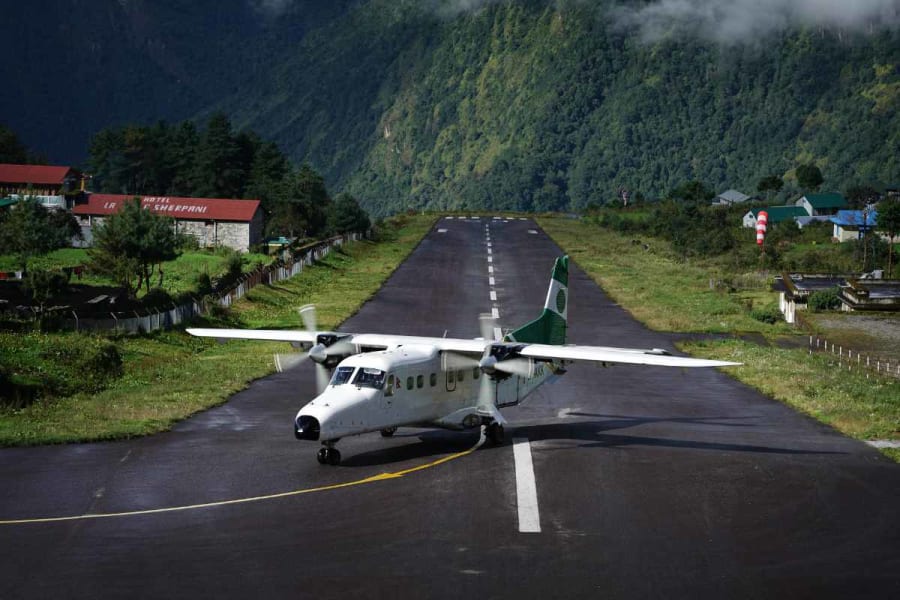
The trail from Lukla to Phakding is an easy one. It traverses through small settlements, forests, and different animals and birds. You will also get a glimpse of mountain peaks like Kusum Kangaru from afar. Crossing suspension bridges, and walking through terrific green landscapes, beside the Dudh Koshi River day one ends at Phakding.
Day 2: Trek form Phakding to Namche Bazar
Today you trek to Namche Bazar. Namche is popularly known as Portal to the majestic Himalayas to trekking enthusiasts. You need two permits. The Khumbu municipality card is checked at Lukla, and the Sagarmatha National Park permit at the park gate in Monjo.
|
Permits |
Cost |
|
Khumbu Pasang Lhamu rural municipality entrance permits (replaces the TIMS card in the Everest region) |
NPR 3,000 per person (NPR 2,000 for SAARC and Chinese nationals) |
|
Sagarmatha national park entry permit |
NPR 3,000 per person (NPR 1,500 for SAARC nationals) |

The trek to Namche Bazar is approximately 6 hours to 7 hours long. The trail is neither too easy nor too hard. You pass through beautiful stone-paved paths, suspension bridges above fast-flowing rivers, panoramic views, and colorful prayer flags. If luck is on your side, while passing through the Sagarmatha National Park, you may catch a glimpse of rare animals like musk deer, red panda, snow leopard, Himalayan black bear, etc.
Since Namche is elevated to a height of 3440 m / 11286 ft the trail starts moving upward, it has long stairs and a few risky steep paths too. Be careful walking through these! Namche Bazar is the most hustling and bustling place of the trek so make sure to have fun here.
Day 3: Acclimatization and hike around Namche
Acclimatization is very much needed for altitude increases, making it hard for our body to adapt. So to avoid complications the day will be spent visiting places nearby like the Local museum and Hillary school, Khumjung village, and Khunde village. These villages reflect the beauty of the Sherpa lifestyle.
You will also get to see views of mountains like Ama Dablam (6,812 m / 22,349 ft), Mount Nuptse (7861 m / 25791 ft), Mount Lhotse(8516 m/ 27940 ft), etc. These small hikes will keep us active and help in acclimatize. After that, you rest and get prepared to advance forward.
Day 4: Namche Bazar to Tengboche
Tengboche is 9.6 km / 6 miles away from Namche Bazar. Today’s trek will be one of the most difficult ones. With all these difficulties it also flaunts the most rewarding view of the entire trek. Mountains, panoramic views, monasteries, faunas, exotic animals, etc., make the trek worth all the hard climb.
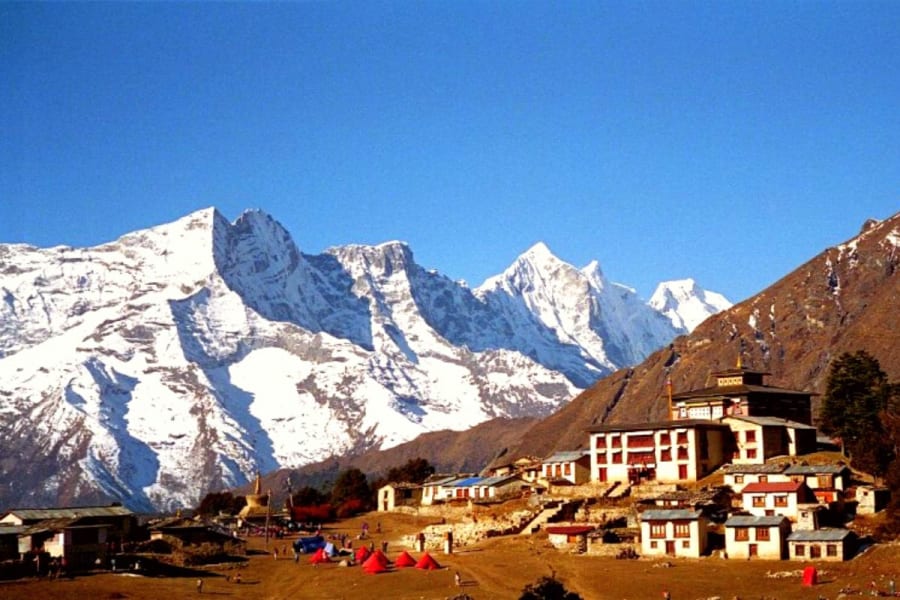
First, the track moves downhill. As you get near the midpoint the elevation starts to get higher. It reaches up to 3,867 m / 12,687 ft. Since the trail goes downhill first and then moves upward it is very hard to get your body adjusted. So, have your first aid kit with you in case something bad happens.
Day 5: Tengboche to Dingboche
Trek from Tengboche to Dingboche is around 6 hours long and fairly challenging. You need to walk past the upslope landscapes. The trail passes through villages like Deboche and Pangboche.
It will be even more difficult to get your body adjusted as the altitude rises to 4410 m / 14470 ft. One gets a close view of Nuptse, Lhotse, and Ama Dablam along with a sneak peek of the majestic Everest.

Day 6: Day for acclimatization at Dingboche
Dingboche is filled with beautiful places for you to discover. Today as an acclimatization hike you visit Nagarjun Peak also known as Nangkartshang peak. It is situated at an altitude of 5083 m / 16676.51 ft. The hike will be approximately 4 hours to 5 hours long. It flaunts the terrific vistas and mountain peaks: Lobuche east (6119 m / 20075.46 ft), Kangtega 6782 m / 22251 ft), Taboche (6495 m / 21309 ft), Thamserku (6,623 m / 21,729 ft), Ama Dablam (6,812 m / 22,349 ft), Lhotse (8516 m/ 27940 ft), Cho Oyu (8188 m / 26864 ft), etc. after completing the acclimatization hike you return back to Dingboche and rest in a teahouse.
Day 7: Dingboche to Lobuche
The elevation keeps increasing and gets to 4,940 m / 16,207 ft. Today on the Everest base camp trek with Helicopter return you will behold the first-ever sight of the Khumbu glacier. Trek to Lobuche doesn’t comprise rocky, steep paths or has any notable obstacle however, one needs to be aware of the risks of gained elevation.
The total distance from Dingboche to Lobuche is 11 km / 6.83508 miles. To complete one needs approximately 4 hours to 5 hours. Lobuche is sparsely populated and has a handful of teahouses. Upon arriving at Lobuche village mountains like Lobuche, Nuptse, and the stunning Everest region comes into sight.
Day 8: Lobuche to Gorakshep, Gorakshep to Everest Base Camp then return back to Gorakshep
This day of the Everest base camp trek with Helicopter return will be the longest and most tiring. First, you leave Lobuche and head for Gorakshep. The trail followed is rocky so be careful while you walk through it. To overshadow all the difficulties the trail also has views of the Mount Nuptse and Khumbu glacier. It will take around 3 hours to get here.
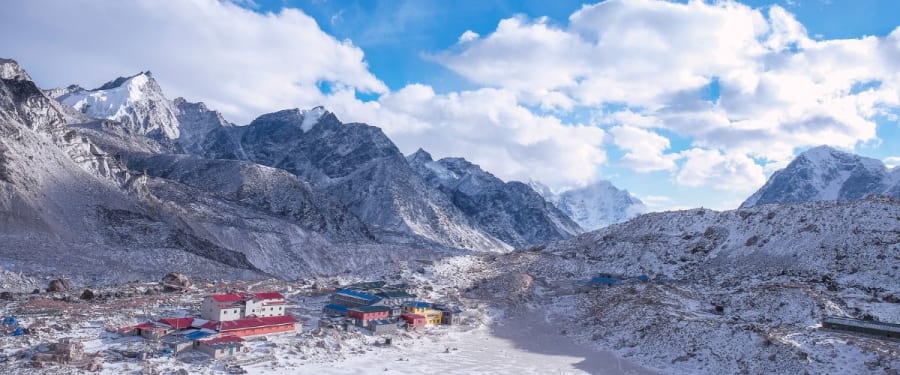
After lunch and a rest at Gorak Shep, the trek goes on to Everest Base Camp. The trail to Everest Base Camp is a difficult one but can be completed in about 2 hours. You will return back to Gorakshep and rest for the night.
Day 9: Gorakshep to Kalapatthar, Kalapatthar to Gorakshep then a Helicopter ride from Gorakshep to Kathmandu
Kalapatthar is one of the best viewpoints of the Everest base camp trek with Helicopter return. It boasts the most magical sunrise and sunset. It has the best and up-close view of Mt. Everest along with other snow-capped mountains like Mt.Lhotse (8516 m /27940 ft), Mt.Nuptse (7861 m / 25791 ft), Mt.Changtse (7543 m / 24747 ft), Mt.Pumori (7161 m/ 23494 ft), etc to stun you.
Trek from Gorakshep to Kalapatthar is 1 hour to 2 hours long. The trail to Kalapatthar can be icy and bitterly cold before dawn, so leave prepared.

After enjoying the magical view from Kalapatthar, you trek back to Gorakshep and take the thrilling Helicopter ride to Kathmandu. The feeling of flying above the Everest region, glaciers, lakes, and small villages is surreal. The helicopter ride takes roughly 60 to 90 minutes, depending on the weather and refuelling stops.
Also read: best time for the Everest Base Camp trek
How Much Does the Helicopter Return Cost?
Our 14-day Everest Base Camp trek starts at USD 1,620. The 10-day version with a helicopter return starts at USD 2,765, so the flight adds roughly USD 1,150 and saves four days. That price assumes a shared helicopter, with seats filled by trekkers from the same group or other groups flying that morning. A private charter from Gorak Shep costs several thousand dollars for the aircraft, split between up to four or five passengers, and the pilot may carry fewer people from that altitude.
Gorak Shep is roughly 150 km from Kathmandu in a straight line. The ride lasts roughly 60 to 90 minutes depending upon weather conditions and refuelling stops. For a Helicopter ride, one does not need any special equipment. Make sure you wear proper clothes according to the weather. Wear windproof down jackets, comfortable trousers, goggles, gloves, and hats.
Walking Out vs Helicopter Return
| Classic trek | Helicopter return | |
|---|---|---|
| Days from Kathmandu | 14 | 10 |
| Days on the trail | 12 | 9 |
| Acclimatisation days | 2 (Namche, Dingboche) | 2 (Namche, Dingboche) |
| Return route | 3 to 4 days walking to Lukla, then fly | 1 morning flight, Gorak Shep to Kathmandu |
| Swotah price from | USD 1,620 | USD 2,765 |
| Weather risk | Lukla flight only | Lukla flight and the helicopter |
| Option | Total trip length |
|---|---|
| Walk out (14 days) | 14 days |
| Helicopter return (10 days) | 10 days |
Is the Helicopter Return Worth It?
For most people with the time, walking out is the better deal. The descent is easier than the ascent, you sleep in thicker air every night, and it costs far less. The helicopter makes sense in three cases. You have only ten days. Your knees struggle on long descents. Or you want to see the Khumbu glacier, Ama Dablam and the Dudh Koshi valley from the air, which no amount of walking can give you.
The drawback is weather. Helicopters fly in the morning, and cloud often closes the valley by late morning. If the flight can't come, you wait at Gorak Shep or walk down to Pheriche and get picked up lower. Keep one spare day in Kathmandu before your international flight.
Are Helicopter Flights Allowed in the Everest Region in 2026?
The Khumbu Pasang Lhamu Rural Municipality announced limits on non-rescue helicopter flights above Lukla from January 2025. In practice, return flights and helicopter tours are operating normally in autumn 2026, and we confirm the status with the operator when you book. Our article on the Everest helicopter flight ban explains the background.
Why Book It With Swotah?
We're a Kathmandu-based company, and our guides grew up in these mountains. They hold Nepal's trekking guide licence, carry first aid, and decide on the spot whether a trekker is fit to go higher. On the helicopter return we book the flight with the operator, match you with other passengers to keep the seat cost down, and rearrange the pickup if the weather turns. See dates and the full day plan on the Everest Base Camp Trek with Helicopter Return page.
Everest Base Camp Helicopter Return: FAQs
Where does the helicopter pick you up?
At Gorak Shep (5,170 m), the morning after you reach base camp, usually after the sunrise climb to Kala Patthar. In bad weather the pickup can move down to Pheriche or Lukla.
How long is the helicopter flight from Gorak Shep to Kathmandu?
About 60 to 90 minutes, including a refuelling stop at Lukla or another landing point on the way.
Is the helicopter return safe for altitude sickness?
Yes. You still climb on foot with two acclimatisation days, and flying down is the fastest cure for altitude symptoms. The risk on any Everest trek comes on the way up.
How much luggage can I take on the helicopter?
Plan on about 15 kg per person, the same as the Lukla flight. A full helicopter at that altitude has little spare lift, so heavy extras may follow on a later flight.
Can I fly back by helicopter from base camp itself?
Helicopters land at Gorak Shep and Kala Patthar, which is where every return pickup happens. Landings at base camp itself are kept for rescues and expedition supply.