
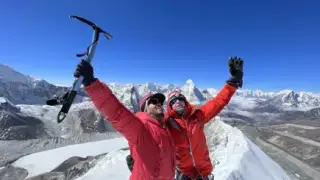
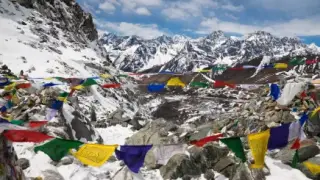


The easiest trekking peaks in Nepal for a first climb are Yala Peak (about 5,500 m) in Langtang, Pokalde (5,806 m) and Island Peak (6,189 m) near Everest, Mera Peak (6,476 m), the highest of them, and Chulu West (6,419 m) and Pisang Peak (6,091 m) on the Annapurna Circuit. They are permitted by the Nepal Mountaineering Association (NMA). Below 6,500 m the permit costs USD 350 in spring and USD 175 in other seasons, and most need only one to four days on the mountain. You still need crampon and fixed-rope skills, good fitness and a licensed climbing guide.
- Easiest for a first summit: Yala Peak (F+) and Pokalde, then Mera (PD)
- Most popular: Island Peak, 6,189 m, often added to the Everest Base Camp trek
- Highest of the seven: Mera Peak, 6,476 m, often called Nepal's highest trekking peak
- Permit (since 1 Sep 2025): USD 350 spring, USD 175 autumn, winter and summer for NMA peaks below 6,500 m
- Above 6,500 m: Chulu East (6,584 m) sits in the higher NMA band, about USD 500 in spring
- Days on the mountain: usually 1 to 4, inside a 14 to 21 day trip
- Skills: crampons, ice axe, harness, jumar on fixed lines, roped glacier travel
- Best seasons: April to May and October to November
You have done a lot of treks in Nepal, from the easier Annapurna treks, and the well-known Everest Base Camp Trek to treks in more remote and challenging areas such as the Everest Three Pass Trek and the Kanchenjunga Circuit Trek. Perhaps you have even ventured to the remote areas of Dolpo and Upper Mustang, but now you want something more challenging.
Or perhaps you have climbed mountains in your country but do not consider yourself an experienced climber. Then, a climbing peak might be the perfect expedition for you.
What is a Trekking Peak?
A trekking peak is one of the roughly 30 mountains the Nepal Mountaineering Association (NMA) issues permits for, rather than the Department of Tourism. Most of the popular ones are below 6,500 m, and the NMA list stops short of 7,000 m. They do not need expedition-style logistics, but they are real climbs on snow and ice, so you will use crampons, an ice axe and fixed ropes. Most need one to four days on the mountain itself. Compare this to Mt Everest, where climbers spend several weeks rotating between base camp and the higher camps to acclimatise. Like Everest, you need a climbing permit, but it is nowhere near as expensive.
The "easy" label is relative. These peaks are easy compared with expedition peaks, not compared with a trek. You will be on a summit day of 8 to 12 hours above 5,500 m, often starting around midnight, so fitness and comfort at altitude matter more than raw technique.
Seven Best Trekking Peaks for Beginners
Plus, a bonus climb for those with more experience!
-
Island Peak 6,189m
-
Mera Peak 6,476m
-
Pokalde Peak 5,806m
-
Lobuche Peak 6,119m
-
Yala Peak about 5,500m
-
Chulu West 6,419m
-
Pisang Peak 6,091m
The Seven Peaks Compared
| Peak | Height | Grade | Region | Permit (spring / other) | Swotah trip | |
|---|---|---|---|---|---|---|
| Yala Peak | about 5,500 m | F+ | Langtang | USD 350 / 175 | 14 days, from USD 1,825 | |
| Pokalde | 5,806 m | Easy, short ridge | Khumbu | USD 350 / 175 | 17 days, from USD 1,850 | |
| Pisang Peak | 6,091 m | PD to PD+ | Manang | USD 350 / 175 | 18 days, from USD 2,095 | |
| Lobuche East | 6,119 m | PD+ | Khumbu | USD 350 / 175 | 18 days, from USD 2,250 | |
| Island Peak | 6,189 m | PD+ | Khumbu | USD 350 / 175 | 18 days, from USD 2,495 | |
| Chulu West | 6,419 m | PD- | Manang | USD 350 / 175 | 19 days, from USD 2,950 | |
| Mera Peak | 6,476 m | PD | Hinku valley, south of Everest | USD 350 / 175 | 16 days, from USD 2,150 | |
| Ama Dablam (bonus) | 6,812 m | Technical, expedition peak | Khumbu | USD 1,000 / 1,000 (Department of Tourism) | 29 days, from USD 6,999 |
Heights and alpine grades follow the NMA peak list as summarised on Wikipedia. Yala is often sold as 5,520 m and one operator lists 5,732 m. Prices are the "From / person" figures on each Swotah trip page on 25 October 2026. Permit fees are per person and match our peak climbing permits guide.
Island Peak 6,189m

This is often the first choice, particularly as it lies near the Everest Base Camp Trekking route and is combined with a trek there.
The climb itself takes one to two days from base camp (about 5,100 m). Our trip is 18 days in all, combined with Everest Base Camp and Kala Patthar for acclimatisation. The best time to go is April to May and October to November.
Its grade is PD+, a step up from ‘a little difficult’. Most of the route is a walk and scramble to the glacier, then a steep headwall of snow and ice on fixed ropes, often with ladders over crevasses on the glacier below it. It is suitable for beginners who have practised with crampons and a jumar, but a good level of physical fitness is required. It certainly also helps if you are familiar and comfortable with being at high altitude.
Mera Peak 6,476m

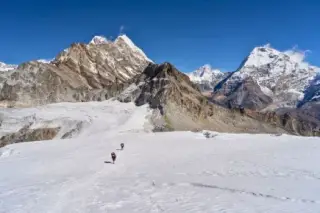
Mera sits in the remote Hinku valley south of Everest, a few valleys from Island Peak. It is often called Nepal’s highest trekking peak, and it is a bit trickier to access, usually by flying to Lukla and crossing the Zatrwa La, but once there the climbing route is not too difficult. It is graded PD, mostly a long, gentle glacier climb with a short steeper section near the top, which makes it a favourite first 6,000 m peak. Our Mera Peak climbing guide covers both approach routes.
Three to 4 days are spent on the mountain, via Khare and high camp at about 5,800 m, while the rest of the time is spent trekking, for a total trip of 16 to 18 days. The best times for this climb are April to May and October to November.
Pokalde Peak 5,806m
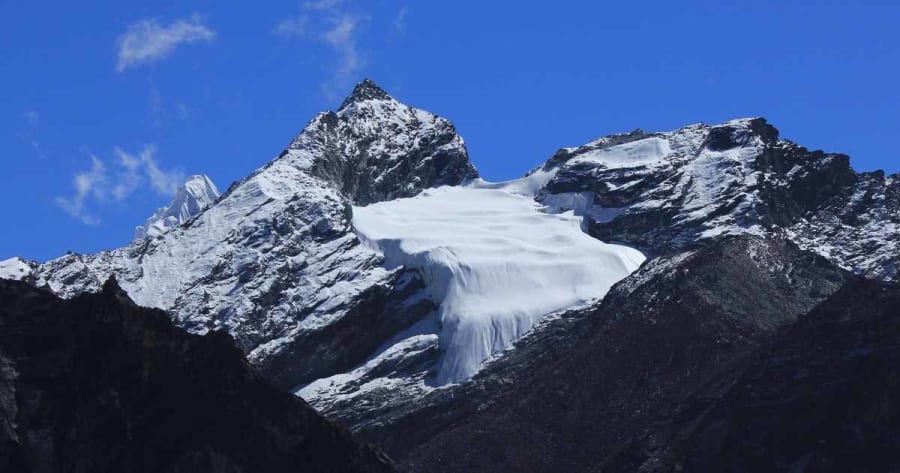
This is the climbing peak with the shortest amount of time actually climbing –one day. This is probably a great climb for those at the very beginning of their climbing journey, with a short rocky summit ridge rather than a long glacier. As usual a good level of fitness is required, as our trip is 17 days, including trekking to Everest Base Camp. Best time to go is April to May and September to October.
Lobuche Peak 6,119m
Again, near Mount Everest, there are two summits here, Lobuche East and the harder Lobuche West, which needs a separate permit. Lobuche East is the one trekking groups climb, and it is suitable for novices who have trained first, but it is steeper than Island Peak or Mera. Three days are required for climbing, with a total trip, including trekking to Everest Base Camp, of around 18 days. The east peak is graded PD+, with a long fixed-rope ridge near the top, so it is one of the harder peaks on this list. Remember there is a long trek involved which will deplete some energy. The best time to go is April to May and October to November. Our Lobuche Peak guide compares it with Island Peak and Mera.
Yala Peak about 5,500m
If you don’t want to fly, Yala Peak is the closest one to Kathmandu, a day’s road journey to the Langtang valley. It is graded F+, meaning ‘fairly easy’ in climbing terms, and it is the easiest summit on this list. Its height is about 5,500 m, although many operators sell it as 5,520 m. With one to two days of actual climbing from Kyanjin Gompa (about 3,870 m), the total trip time is around 14 days combined with travel and trekking. The best time to go is March to May and October to November.
After the 26 August 2026 flood, the Langtang road ends at a new trailhead at Thulo Syabru, reached via Dhunche. The valley reopened for trekking on 22 October 2026. Our flood trekking update has the latest access details.
Chulu West 6,419m and Chulu East 6,584m

Lying near the Annapurna Circuit Trail there are also two summits, Chulu West (6,419 m) and Chulu East (6,584 m). They need separate permits, and Chulu East is above 6,500 m, so its NMA permit sits in the higher band of about USD 500 in spring. Expect two to four days on the mountain, depending on the summit and the snow. Chulu West is graded around PD (sources range from PD- to PD+) and is one of the more demanding peaks here, with a loose rock band and steep snow on fixed ropes, so a good level of fitness and stamina is required. Our trips are 19 days (Chulu West) and 21 days (Chulu East). The best time to go is March to May and September to November.
Pisang Peak 6,091m
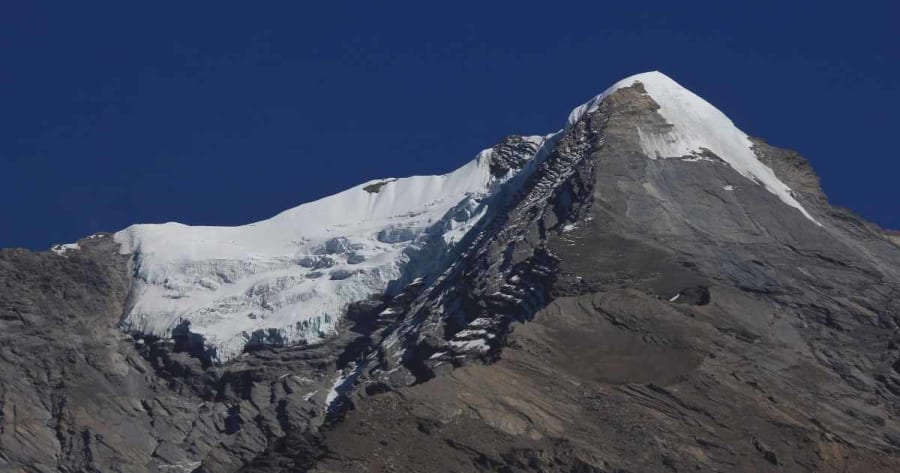
Still near the Annapurna Circuit Trail, above Upper Pisang, this summit is a little technical and best for those with a higher level of fitness and some climbing experience. It is graded PD, and climbers rate the newer west ridge route a solid PD+ because of its steep, exposed upper snow slope. Actual climbing time is 2 to 3 days while our whole trip takes 18 days. The best time to go is March to May and September to November.
Ama Dablam 6,812m (bonus climb for those with a lot more experience)
For those who are not beginners at all, this might be the next step. Ama Dablam is not an NMA trekking peak. It is an expedition peak permitted by the Department of Tourism, with a royalty of USD 1,000 in spring and autumn. To summit is difficult due to steep rock, snowy ridges and ice cliffs, and it is one of the most climbed mountains in Nepal after Everest. Expect around two weeks on the mountain inside a trip of about four weeks (ours is 29 days). It is much harder than anything else on this list, and it is not for everyone. The best time to go is April to May and October to November.
Skills You Need Before Your First Trekking Peak
None of these peaks needs previous Himalayan experience, but each one assumes you can use basic climbing gear on steep snow while tired and short of breath. Most groups get a training session at base camp, which is a refresher, not a course. Practising at home on a winter skills or glacier course makes summit day far safer and more enjoyable.
| Skill | Why it matters | Where you use it |
|---|---|---|
| Walking in crampons | Every peak here has a snow or ice section | All seven |
| Ice axe use and self-arrest | Stops a slip on a snow slope | All seven |
| Ascending fixed ropes with a jumar | Headwalls and ridges are fixed with rope | Island, Lobuche East, Pisang, Chulu |
| Abseiling or arm-wrap descent | Coming back down the fixed lines | Island, Lobuche East, Pisang |
| Roped glacier travel | Crevasses on the approach | Island, Mera, Chulu |
| Ladder crossings | Aluminium ladders over crevasses | Island Peak in most seasons |
| Pacing at altitude | Summit days run 8 to 12 hours above 5,500 m | All seven |
Ask your operator what the guide-to-client ratio is on summit day. Nepal's 2025 mountaineering rules set one guide for every two climbers on the big peaks, and a similar ratio is a good benchmark on trekking peaks. Since April 2023 foreign trekkers also need a licensed guide on most routes in Nepal, and NMA permits are only issued through a registered agency. Our training plan and altitude sickness guide help with the fitness and acclimatisation side.
What to Pack for Trekking Peak Expeditions
You will pack much the same as for a high-altitude trekking trip, plus climbing gear. See the list below.
For the climb you also need insulated mountaineering boots that take crampons, a harness, helmet, ice axe, jumar and a belay or descender device. The team ropes are provided by your operator, and some include the personal gear too, so check with your Nepal tour agency. You can also hire most of it in Kathmandu. Our trekking gear list has a peak climbing add-on table.

• Sun lotion
• Sun glasses – even when not sunny, you are often at high altitudes when the effects of the sun’s rays are stronger.
• Sun hat
• A warm hat for cold weather. You may even need it in bed too.
• Buff or scarf. Buff is easier to carry, and you can use it for other things too i.e., mask, headband.
• When buying/ packing underwear, go for something that is both quick drying (for washing on the trail) and which absorb moisture from your body.
• Trekking shirts* are great because they are specially made for keeping you dry on treks. I suggest 3 or 4 of these for longer treks.
• Fleece jacket* for warmth.
• Jacket for over the fleece such as a down jacket*
• Rain jacket for the obvious!
• Rain over-trousers if trekking in the monsoon season
• Trekking trousers and shorts* – again those made specifically for trekking are best
• Gloves – both inner gloves and thicker insulation gloves if you are going very high or into snowy conditions
• Hiking socks – again 3 or 4 pairs
• Hiking boots – wear them in before going on the trek!
• Footwear like trainers or sandals for in the lodges and to give your feet a rest from the boots
• Good backpack and day pack
• Sleeping bag** and inner sleeping bag/sheet
• Quick drying towels
• Hiking poles*
• Headlight – easier to use than the traditional hand-held torch
• Feminine hygiene products
• Wet wipes – maybe not many showers on the way or too cold to strip off to use them.
• Water purifier tablets or a filter bottle
• Your usual toiletries like lip balm and toothpaste
• Any medicines you usually use as well as a basic first aid kit
• Passport/ money/ insurance
*You can buy in Kathmandu on your arrival
** You can hire in Kathmandu. Some trekking agencies will provide a sleeping bag for their clients.
Cost of Peak Climbing
Peak climbing is by no means an inexpensive Himalayan trekking trip. To reach the climbing destination, specialist guides and porters are required on top of the cost of the normal trekking. But the experience of seeing the Himalayas up close and pushing your body to its limits makes it worthwhile. Not to mention for those who have never climbed before, it is an introduction to a new activity. And who knows what/ where you will climb next!
Here is what goes into the price on top of a normal trek:
- NMA permit: USD 350 in spring, USD 175 in autumn, winter and summer for peaks below 6,500 m (since 1 September 2025)
- Peaks above 6,500 m: about USD 500 in spring, for example Chulu East
- Garbage deposit: refundable, about USD 500 per team on a small Khumbu peak, paid by your agency
- Liaison officer: not needed for peaks below 6,500 m
- Climbing guide and gear: a climbing guide is paid more than a trekking guide, and gear hire adds to the bill
- Insurance: a mountaineering policy that covers your peak's height and helicopter rescue
Our trips run from USD 1,825 for Yala Peak to USD 2,950 for Chulu West, as listed in the table above. The peak climbing permits guide has the full fee table, and the insurance guide explains altitude cover.
Is Peak Climbing Safe?
Many people ask if it is safe to travel in Nepal and what is the latest Nepal travel advice and safety.
All trekking and climbing have some risks involved, and therefore, it is important to go with a properly registered and experienced trekking company. It is also important to work on your fitness before you arrive. However, no amount of hours in the gym can prepare you for hiking uphill at altitude! But having a base level of fitness is important.
My two best pieces of advice are:
1. Never trek or climb alone. A licensed guide has been required on most trekking routes since April 2023, and every NMA peak is climbed with a guide through a registered agency.
2. Always listen to your guide and take their advice.
Forewarn friends and family that networks may not work in some areas, so they should not panic because you haven’t posted a daily update! That said, someone should be able to check in on you – through your trekking agency – if you do not make it back on the assigned day.
Overall, trekking and/ or climbing with a registered travel company in Nepal, and listening to and doing what the guide says (for example, if you are suffering from altitude sickness, your ability to make decisions may be impaired, and you may think you can carry on when you should be going down to a lower altitude) means you are in safe and experienced hands.
FAQ: Trekking Peaks for Beginners
What is the easiest trekking peak in Nepal?
Yala Peak in Langtang, at about 5,500 m and graded F+, is the easiest. Pokalde near Everest is also short and gentle. Of the 6,000 m peaks, Mera (PD) is the least technical, though it is the highest of the seven.
Can a complete beginner climb Island Peak?
Yes, if you are fit, acclimatise well and practise with crampons and a jumar first. Island Peak is graded PD+, with a steep fixed-rope headwall near the summit, so a winter skills course at home is worth doing.
How much does a trekking peak permit cost?
For NMA peaks below 6,500 m the permit is USD 350 in spring and USD 175 in autumn, winter and summer, since 1 September 2025. Peaks above 6,500 m cost about USD 500 in spring.
Do I need a guide to climb a trekking peak?
Yes. NMA permits are issued through registered agencies, and climbing with a licensed guide is the norm on every peak on this list.
Is Ama Dablam a trekking peak?
No. Ama Dablam (6,812 m) is an expedition peak permitted by the Department of Tourism, with a USD 1,000 royalty in spring and autumn. It is far more technical than the NMA trekking peaks.